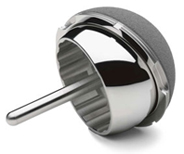
Well, the more people I meet, the more I hear about becoming bionic – with all types of body parts being replaced…it’s pretty surreal, especially when you go through it yourself.

Well, the more people I meet, the more I hear about becoming bionic – with all types of body parts being replaced…it’s pretty surreal, especially when you go through it yourself.

It is important to be your own advocate and know WHAT TO ASK FOR IN THE HOSPITAL! WATCH THIS VIDEO….
AND have a HIP BUDDY!

In an advance toward a new generation of improved hip and other joint replacements, scientists are describing development of a potential implant material that flexes more like natural bone, fosters the growth of bone that keeps implants firmly in place and is less likely to fail and require repeat surgery. Their study on these so-called tantalum nanotube materials appears in ACS Applied Material & Interfaces.
Toward a better material for hip replacement and other joint implants
Here’s a list of questions that may be helpful to ask your doctor before your hip surgery. We suggest you print this list and take it with you on your appointment.
Sources of common metal exposure are:
• Dental restorations: fillings, crowns, pins, root-fillings, implants. Amalgam/silver fillings contain mercury, silver, tin, copper and zinc. Crown can contain gold, silver, palladium, copper, chromium, indium, gallium, iridium, nickel and more. Implants are often made of titanium, aluminium and vanadium.
• Orthopedic and body implants such as hip replacements, screws, nails, clips, usually made from titanium or stainless steel.
• Common implant alloys are:
• Stainless steel: Nickel, chromium, manganese, molybdenum
• Cobalt-chromium molybdenum steel: Chromium, molybdenum, nickel, iron, manganese, tungsten, aluminum, titanium, cobalt
• Vitallium: Cobalt, chromium, manganese, molybdenum
• Titanium: Aluminum, vanadium, nickel (trace)
You’re NOT Alone!
Click to join hip_hip_replacement
If you’ve landed on this site – you have either been initiated into the Club with a hip replacement or two, OR you are researching that path. Within the pages of this community, you are able to sign up for HIP tele-classes and support groups; and we are establishing HIP Happy Hours state-wide.
It’s here you’ll find the latest research, articles, testimonials and most importantly you’ll meet other hipsters of all ages who have joined the ranks of bionic.
Hip Hip Hurray – you’ve found a home — people who KNOW what you’ve gone through or ARE going through. We’ll support you and hold you hand along the way!
For more information, please email me at Jodiseidler@hipsterclub.com.
Meridian Tooth Chart Shows Teeth and Organ Relationships
The front teeth are connected to the kidneys. The stomach is connected to the premolars. This is something that practitioners of Traditional Chinese Medicine have known for thousands of years.
Most people are familiar with Chinese Medicine or acupuncture and have heard about meridians , the channels through which energy flows in the body. Each organ, gland and body structure has an associated meridian, including the teeth.
What does all this mean to health and wellness? Well, if someone has a bad tooth, the energy flow through the meridian belonging to that tooth will be altered. This in turn can affect the health of all the other organs on that meridian. For example, Tooth Number 14, the upper left first molar tooth, is on the same meridian with the kidneys, liver, spleen, stomach and breast. So, if this tooth has a problem, it may affect energy flow through the meridian, and the health of those organs may be affected as well.
via Meridian Tooth Chart Shows Teeth and Organ Relationships
The prosthetic implants are being developed by scientists at Glasgow University in collaboration with orthopaedic surgeons at the city’s Southern General Hospital and they hope to have a prototype ready within 10 years.
The move follows a breakthrough last year by a team at the university’s Institute of Molecular, Cell and Systems Biology when they succeeded in creating a special plastic surface capable of controlling what stem cells become – a technique that was previously impossible.
The plastic is covered in tiny pits 120 nanometres across which, when stem cells are placed on the surface, encourages them to grow and spread across the pits in a way which ensures they differentiate into therapeutically useful cells.
While the implant itself will be made of an advanced polymer, already commonly used in spinal and other orthopaedic procedures, it will be coated for the first time in the university’s unique plastic. As a result, once inserted into a patient’s bone marrow – a rich source of mesenchymal stem cells – these can be made to divide and differentiate into fresh bone cells, creating a much stronger and more durable implant.



 Hipster Club